


Project Overview
Client: Residential Property Owner
Location: 1531 Ericson Pl, Bronx, NY 10461, situated in the Morris Park section of the Bronx, a quiet residential enclave known for its tree-lined streets, detached single- and two-family homes, and traditionally well-kept sidewalks. The property sits just minutes from Morris Park Avenue, Jacobi Medical Center, Albert Einstein College of Medicine, and Pelham Bay Park, drawing a steady mix of residents, students, hospital staff, and visitors past the property throughout the day. Like much of the older Bronx housing stock, the block has spent decades absorbing seasonal weather swings and the slow, persistent push of mature street tree roots, both of which had caught up with this sidewalk.
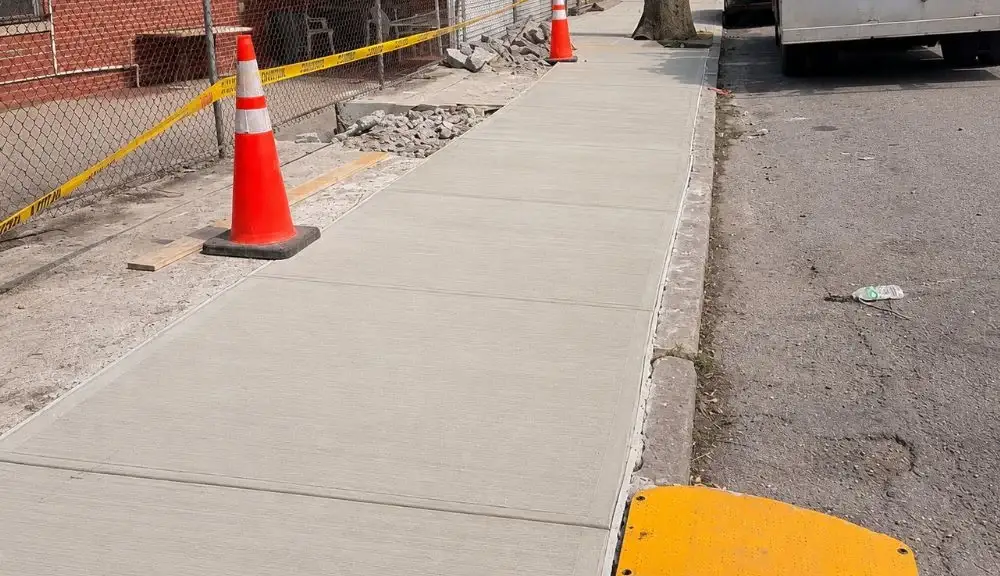
Service Provided: NYC DOT sidewalk violation removal and replacement of 11 damaged sidewalk flags totaling approximately 275 square feet, along with root barrier installation and tree root pruning per NYC Parks tree work requirements.
Permits Required:
- Sidewalk Construction/Repair Permit
- Sidewalk Closing Permit
- Tree Work Permit (required due to the adjacent street tree and root-related sidewalk damage)
- 811 Ticket for utility marking to ensure safe excavation
Permit Fee: $70 (fixed rate for up to 300 linear feet) for the sidewalk construction permit, and $70 for the sidewalk closing permit. The tree-work permit and 811 ticket carried no fee, so the total permit cost was $140.
Estimated Project Cost: $5,173 + $140 = $5,313.
Project Execution Timeline: Approximately two working days after permits were secured, with the repair itself completed in a single day. Work was scheduled during off-peak hours to keep pedestrian access safe and minimize disruption to nearby residents and passersby.
Morris Park doesn't carry the foot-traffic intensity of a commercial avenue, but its sidewalks face a different kind of long-term wear: decades of exposure to freeze-thaw cycles, mature street trees planted close to the curb, and the gradual settling that comes with an older residential grid. At 1531 Ericson Pl, that slow accumulation had reached a tipping point. Eleven flags along the property's frontage had cracked, heaved, or settled unevenly, largely due to an adjacent street tree whose root system had spread beneath the concrete over many years.
For a homeowner in a family-oriented neighborhood close to two major medical institutions, the stakes went beyond curb appeal. An active DOT violation meant real financial exposure, and an uneven sidewalk posed a genuine tripping risk for neighbors, dog walkers, and hospital staff cutting through on their commute. The scale of the damage, nearly the length of the property, meant this repair needed a comprehensive approach rather than a patch-and-go fix.
Challenges We Found on the Ground
Before the repairs, we found several distinct challenges on the site:
DOT Violation: The property owner had received a NYC DOT sidewalk violation covering a significant stretch of frontage, putting them at risk of continued fines until all eleven damaged flags were brought up to code.
Extensive Root Intrusion: The scale of the damage was unusually widespread for a residential lot, with root growth from a mature street tree affecting nearly the entire sidewalk frontage rather than an isolated section.
Large Repair Footprint: At roughly 275 square feet across 11 flags, this project required significantly more excavation, formwork, and concrete than a typical single- or double-flag repair, demanding careful sequencing to keep the timeline tight.
Tree Preservation Requirements: Because the root damage stemmed from a protected street tree, any excavation required NYC Parks coordination and a tree work permit, adding regulatory steps beyond a standard sidewalk repair and requiring extra care to avoid harming the tree during root pruning.
This project called for a solution that resolved the violation across the full length of damaged sidewalk, addressed the root intrusion at its source, and protected the neighborhood's mature tree canopy, all while returning the property to a safe, compliant condition for residents and neighbors.
The Restoration Process Executed by Eden General Construction Inc.
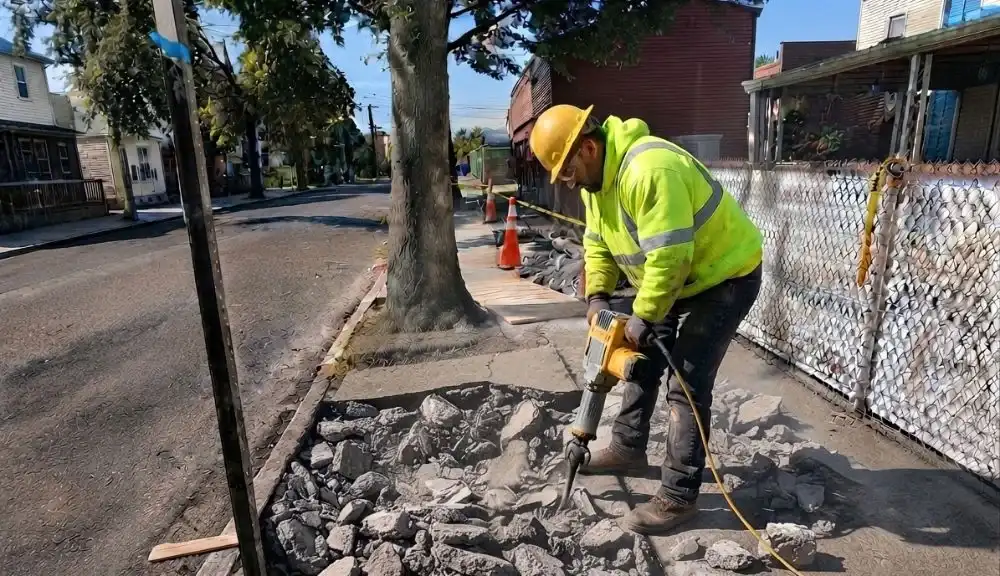
We began with a full site inspection to assess the extent of the damage across all eleven flags and to map how far the root system extended beneath the sidewalk. Given the scope of the repair and the involvement of a street tree, three permits were required: a sidewalk construction permit, a sidewalk closing permit, and a tree work permit from NYC Parks. An 811 ticket was also filed to have utility lines marked before any excavation began.
Step 1: Prepared the Site
Once permits were approved, our crew set up safety cones, barricades, and caution tape along the full length of the work zone. A protected walkway was maintained for residents and pedestrians throughout the project, and access to neighboring driveways and entrances was preserved.
Step 2: Excavated and Inspected the Root Damage
The team saw-cut all eleven damaged flags along existing joint lines to allow for clean, controlled removal. As the old concrete was lifted out, the full extent of the root network became visible, with roots running beneath a large portion of the sidewalk and lifting several flags out of level at varying degrees.
Step 3: Root Management and Barrier Installation
Working under the NYC Parks tree work permit, an arborist-guided crew pruned the roots contributing to the displacement, prioritizing the tree's long-term health throughout the process. A continuous root barrier was then installed along the sidewalk edge to redirect future root growth downward and away from the new concrete, reducing the risk of repeat damage across this larger repair area.
Step 4: Concrete Pouring and Final Finishing
With the root barrier in place, the crew excavated the full repair area and laid a compacted crushed stone subbase before setting new forms across all eleven flags. DOT-approved, air-entrained concrete rated for 4,000 psi compressive strength was poured to withstand the Bronx's freeze-thaw winters. A broom finish was applied for slip resistance, with expansion joints carefully placed to accommodate the tree's ongoing root growth and reduce the likelihood of future cracking.
The concrete cured for approximately two weeks, during which barricades remained in place and the site was monitored regularly for both pedestrian safety and the tree's condition. All work was completed to NYC DOT and NYC Parks standards, fully resolving the violation.
What the Repair Delivered
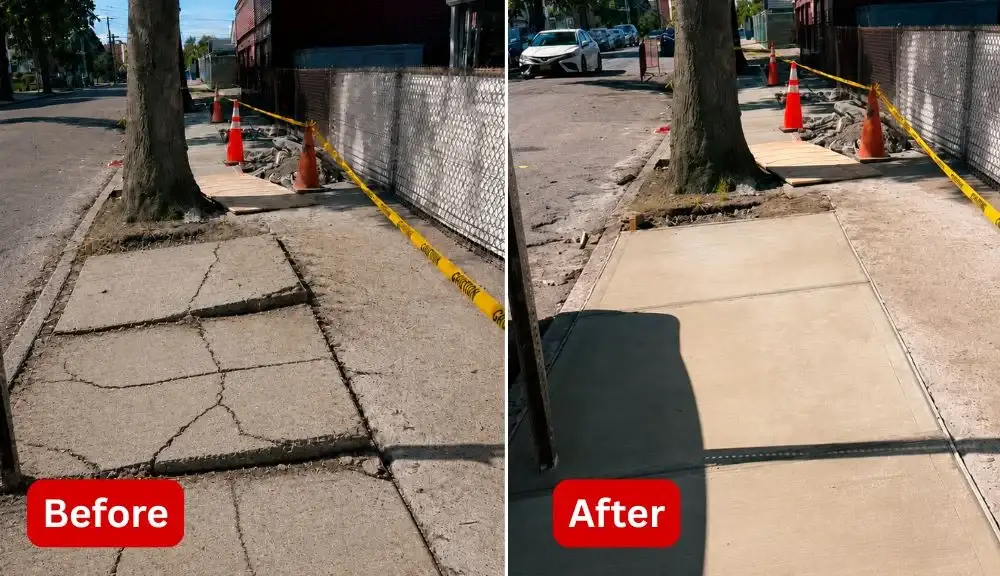
The transformation addressed both the scale of the visible damage and its underlying cause.
Before:
- Eleven sidewalk flags were cracked, heaved, or unevenly settled due to extensive tree root growth.
- The property carried an active NYC DOT sidewalk violation spanning a large section of frontage.
- Uneven concrete across a wide area created a significant tripping hazard for residents and pedestrians.
- No barrier existed to stop the root system from continuing to displace the sidewalk.
- The property's frontage appeared worn and out of step with the well-kept homes nearby.
After:
- Smooth, level, and durable concrete restored across all eleven flags.
- DOT violation fully resolved, bringing the property back into compliance.
- Root barrier installed to protect the new sidewalk from future root intrusion.
- Street tree preserved and responsibly pruned in compliance with NYC Parks requirements.
- A clean, consistent sidewalk frontage that matches the character of the surrounding block.
What This Project Achieved
The completed project delivered lasting value for the property owner and the surrounding block alike.
Most importantly, the NYC DOT violation was fully resolved across the entire affected frontage, eliminating the property owner's exposure to continued fines. By addressing the root cause rather than simply replacing concrete, the repair included a root barrier system designed to prevent the same widespread damage from recurring in the years ahead.
Equally important, the scale of this project didn't come at the expense of the neighborhood's tree canopy. Coordinating with NYC Parks under a tree work permit meant the mature street tree could be pruned and preserved rather than removed, protecting a long-standing piece of the block's greenery while still resolving the hazard it had created.
For a residential property in a quiet, community-oriented pocket of the Bronx like Morris Park, the result is a safer, more cohesive sidewalk that residents, neighbors, and passersby can rely on.
Client Feedback
While the client chose not to disclose their name, their satisfaction is evident. By praising Eden General Construction Inc., they expressed:
"We knew the sidewalk was bad, but we didn't realize how many flags were actually affected until Eden walked us through it. They handled every permit, worked around the tree without any issues, and got the whole thing done fast. Our street looks like a street again, and we don't have to worry about that violation anymore."
The Bottom Line
The sidewalk violation removal and tree root damage restoration project at 1531 Ericson Pl reflects our ability to manage large-scale residential repairs involving mature street trees without sacrificing quality or timeline. By combining full DOT compliance, careful tree preservation, and durable root management across an extended repair area, our team delivered a safe, lasting result for the Morris Park community.