

Project Overview
Client: Mixed-Use Commercial Property Owner
Location: 324 2nd Ave, New York, NY 10003, situated in Manhattan's East Village along a vibrant commercial corridor lined with restaurants, cafés, and neighborhood shops, with residential apartments above. Just steps from St. Mark's Place, Tompkins Square Park, and NYU, the property sees a constant flow of residents, students, office workers, and visitors throughout the day.
Service Provided: NYC DOT sidewalk violation removal and replacement of two damaged sidewalk flags with approximately 50 square feet, along with root barrier installation and tree root pruning per NYC Parks tree work requirements.
Permits Required:
- Sidewalk Construction/Repair Permit
- Sidewalk Closing Permit
- Tree Work Permit (required due to the adjacent street tree and root-related sidewalk damage)
- 811 Ticket for utility marking to ensure safe excavation
Permit Fee: $70 (fixed rate for up to 300 linear feet) for the sidewalk construction permit, and $70 for the sidewalk closing permit. The tree-work permit and 811 ticket carried no fee, so the total permit cost is $140
Estimated Project Cost: $3,843 + $140 = $3,983.
Project Execution Timeline: Approximately two working days after permits were secured, with the repair itself completed in a single day. Work was scheduled during off-peak hours to keep pedestrian access safe and minimize disruption to nearby businesses and residents.
Sidewalks in Manhattan's East Village carry a different kind of pressure than quieter residential blocks. They absorb the daily rhythm of a neighborhood that never really slows down: residents heading to the subway, students walking to class, café regulars, and a steady stream of foot traffic drawn in from St. Mark's Place and Tompkins Square Park. At 324 2nd Ave, this pressure was compounded by something less visible from street level: a mature street tree whose roots had been quietly pushing up against the sidewalk for years.
Two sidewalk flags near the tree had cracked and heaved as a result, creating both a tripping hazard and an active NYC DOT violation. For a mixed-use building with ground-floor retail and residential tenants above, the situation demanded more than a simple concrete patch. The root cause needed to be addressed, not just the surface damage.
What Unique Challenges the Site Presented
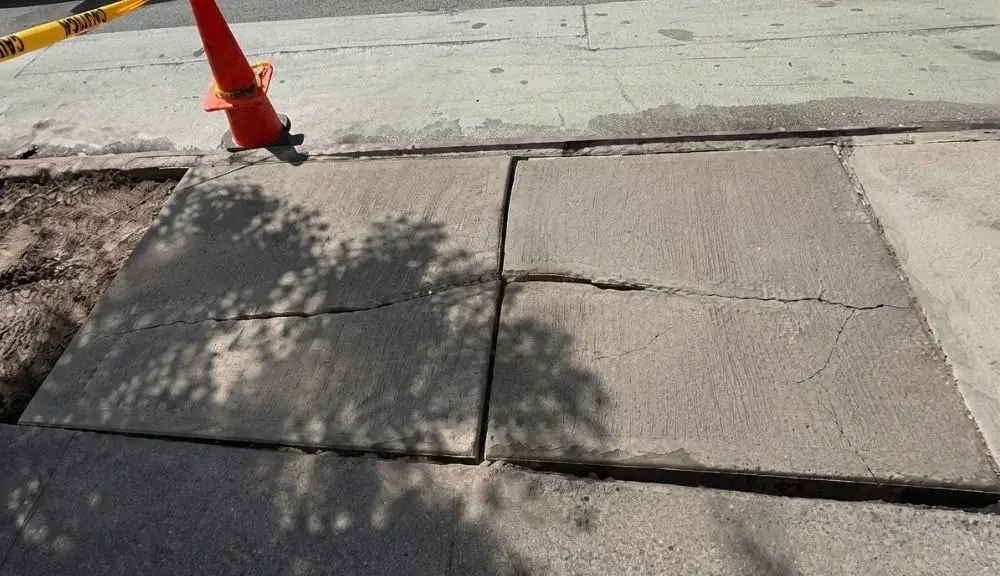
Before the repairs, the site presented several distinct challenges:
DOT Violation: The property owner had received a NYC DOT sidewalk violation, exposing them to fines and continued liability until the damaged flags were properly repaired.
Root-Related Damage: Unlike ordinary wear and tear, the cracking here traced back to an adjacent street tree, whose roots had grown beneath the sidewalk and gradually lifted two flags out of alignment.
High Foot Traffic: With ground-floor retail below and residential units above, the sidewalk saw constant use from tenants, customers, and neighborhood pedestrians throughout the day.
Tree Preservation Requirements: Any excavation near the tree required coordination with NYC Parks to protect the root system and comply with tree work permitting, adding a layer of regulatory complexity beyond a standard sidewalk repair.
This project called for a solution that resolved the DOT violation, addressed the underlying root intrusion with a permanent barrier, and preserved the health of the street tree, all while keeping the sidewalk safe for the building's residents and retail customers.
How Eden General Construction Inc. Restored the Sidewalk
We started with a full site inspection to evaluate both the sidewalk damage and the extent of root intrusion beneath it. Because the repair involved a street tree, the scope required three permits: a sidewalk construction permit, a sidewalk closing permit, and a tree work permit from NYC Parks. We also filed an 811 ticket to have utility lines marked before any excavation began, ensuring the crew could dig safely near existing infrastructure.
Step 1: Prepared the Site
Once permits were approved, our crew arrived on site and set up safety cones, barricades, and caution tape around the work zone. Pedestrians were redirected along a protected walkway, and the storefront below remained accessible to customers throughout the project.
Step 2: Excavated and Inspected the Root Damage
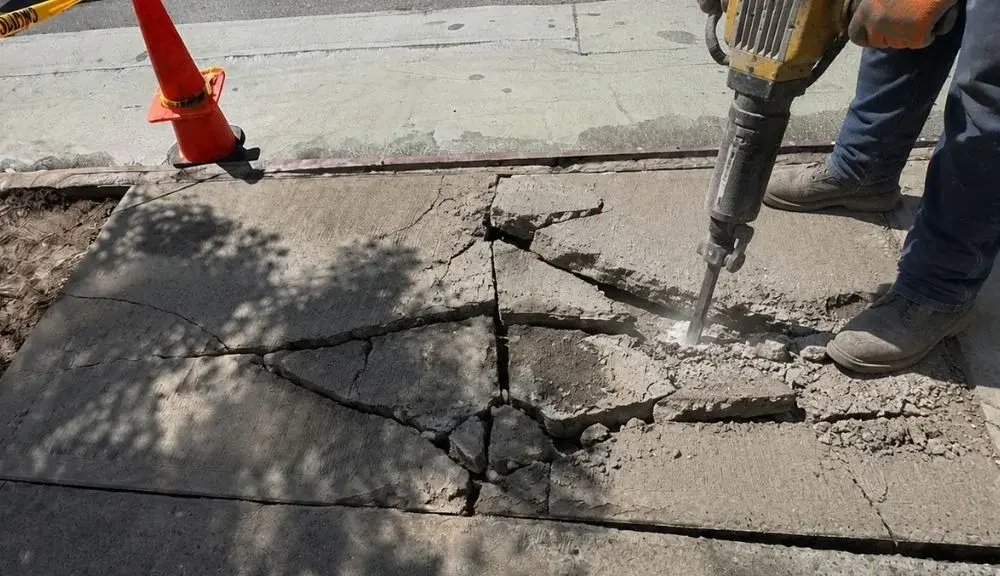
The team saw-cut the two damaged flags along the existing joint lines for clean, targeted removal. As the old concrete came out, the extent of the root intrusion became clear: a network of roots from the adjacent street tree had grown directly beneath the flags, gradually pushing them out of level over time.
Step 3: Root Management and Barrier Installation
Working under the NYC Parks tree work permit, an arborist-guided crew carefully pruned the roots responsible for the displacement, taking care not to compromise the tree's health or stability. A root barrier system was then installed along the sidewalk edge, designed to redirect future root growth downward and away from the concrete, reducing the likelihood of repeat damage.
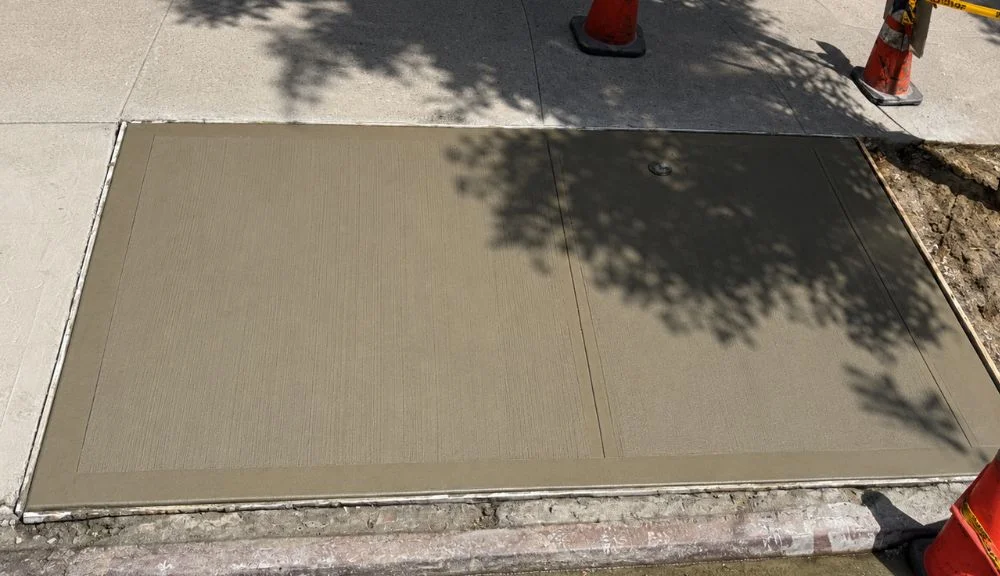
With the root barrier in place, the team excavated the area and prepared a compacted crushed stone subbase before setting new forms. DOT-approved, air-entrained concrete rated for 4,000 psi compressive strength was poured to withstand NYC's freeze-thaw cycles. The surface received a broom finish for slip resistance, with joints placed to accommodate the tree's ongoing root growth and help prevent future cracking.
The concrete cured for approximately two weeks, during which safety barricades remained in place and the site was checked regularly to ensure both pedestrian safety and the tree's continued well-being. All work was completed to NYC DOT and NYC Parks standards, fully resolving the violation.
Results After Completion
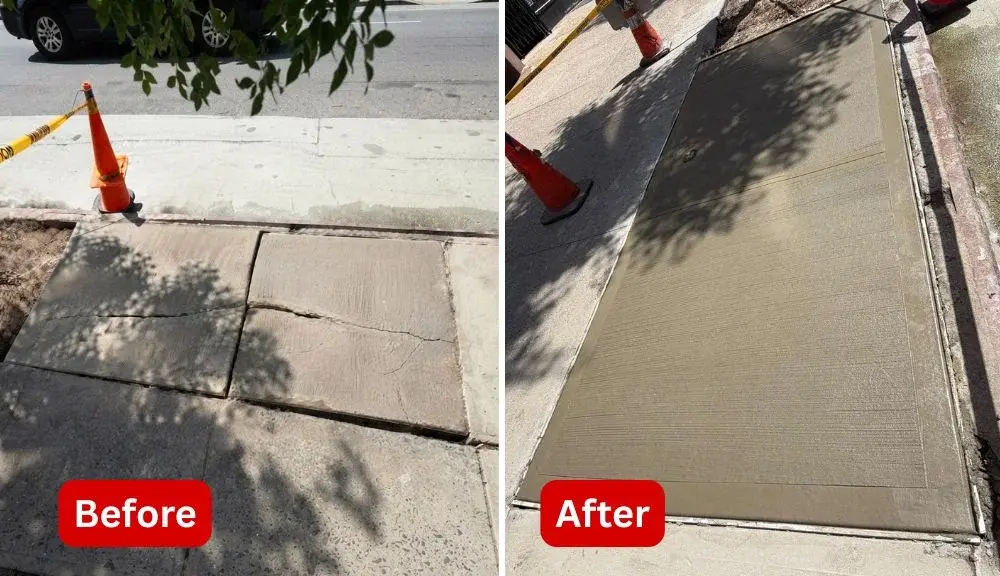
The transformation addressed both the visible damage and its underlying cause.
Before:
- Two sidewalk flags were cracked and heaved by underlying tree root growth.
- The property carried an active NYC DOT sidewalk violation.
- Uneven, lifted concrete created a tripping hazard for residents and pedestrians.
- No barrier existed to prevent the root system from causing further displacement.
- The entrance area appeared uneven and neglected.
After:
- Smooth, level, and durable concrete surface restored across both flags.
- DOT violation fully resolved, bringing the property into compliance.
- Root barrier installed to protect the new sidewalk from future root intrusion.
- Street tree preserved and pruned in compliance with NYC Parks requirements.
- Clean, welcoming entrance for residential tenants and retail customers alike.
Project Outcomes
The completed project delivered lasting value for the property owner, tenants, and the neighborhood tree canopy alike.
Most importantly, the NYC DOT violation was fully resolved, removing the property owner's exposure to fines and ongoing liability. By identifying the root cause of the damage rather than simply patching the surface, the repair included a root barrier system designed to prevent the same issue from recurring in the years ahead.
Equally important, the project balanced sidewalk safety with tree preservation. Coordinating the repair with an NYC Parks tree work permit meant the mature street tree could be pruned responsibly rather than removed, protecting a piece of the neighborhood's green canopy while still resolving the hazard it had created.
For a mixed-use building in a high-foot-traffic corridor like 2nd Avenue, the result is a safer, more attractive entrance for both residential tenants and ground-floor retail customers.
Client's Testimonial
While the client chose not to disclose their name, their satisfaction is evident. By praising Eden General Construction Inc., they expressed:
"We had no idea our sidewalk issue was actually a tree root problem until Eden explained it during their inspection. They handled the permits, the tree work, and the concrete replacement without a single disruption to our retail tenant or the building's residents. The sidewalk looks fantastic, and it's reassuring to know they addressed the real cause instead of just patching it over."
Final Verdict
The sidewalk violation removal and tree root damage restoration project at 324 2nd Ave reflects our ability to navigate the layered permitting and technical demands of repairs involving street trees in dense, high-traffic neighborhoods like the East Village. By combining DOT compliance, tree preservation, and lasting root management, our team delivered a safe, durable, and fully compliant result with minimal disruption to residents and businesses alike.